When the District said, “He doesn’t qualify for Special Education”
If your child is being described as “off task” or “refusing to work,” but no one can clearly explain why, that is something you should not ignore.
As a parent, you often feel it before anyone can clearly define it. You see it in the way your child comes home, in their frustration, and in the subtle changes that build over time.
Then you sit in a meeting and hear, “We don’t see enough,” or “They don’t qualify.”
At the same time, you are thinking, “That’s not right.”
I want to walk you through what this actually looks like in real life, not the version written in reports, but what families experience over time.
I recently worked with a student—let’s call him Michael—where this process unfolded over nearly a year.
We began where many families begin. Concerns were raised, evaluations were completed, and the district determined there was no need for special education services.
On paper, it was a denial. In reality, the concerns did not go away. Over time, what had been minimized during evaluations became more visible in the school environment.
Michael struggled with peer interactions, executive functioning, and sensory processing. His frustration increased as his needs continued to go unmet, reflecting the same concerns his parents had raised from the beginning.
Situations that could have been addressed early escalated into safety concerns, including physical altercations with peers. What was once considered “not significant” became impossible to ignore.
This is where teams often get it wrong, even with good intentions.
The behavior becomes visible, but the underlying cause is still being missed.
When executive functioning is not clearly identified in the evaluation process, behavior is often misunderstood, and support is delayed.
This is also where many parents feel stuck. A denial can feel final.
It is not.
This is where the work begins, and it is also where the approach matters.
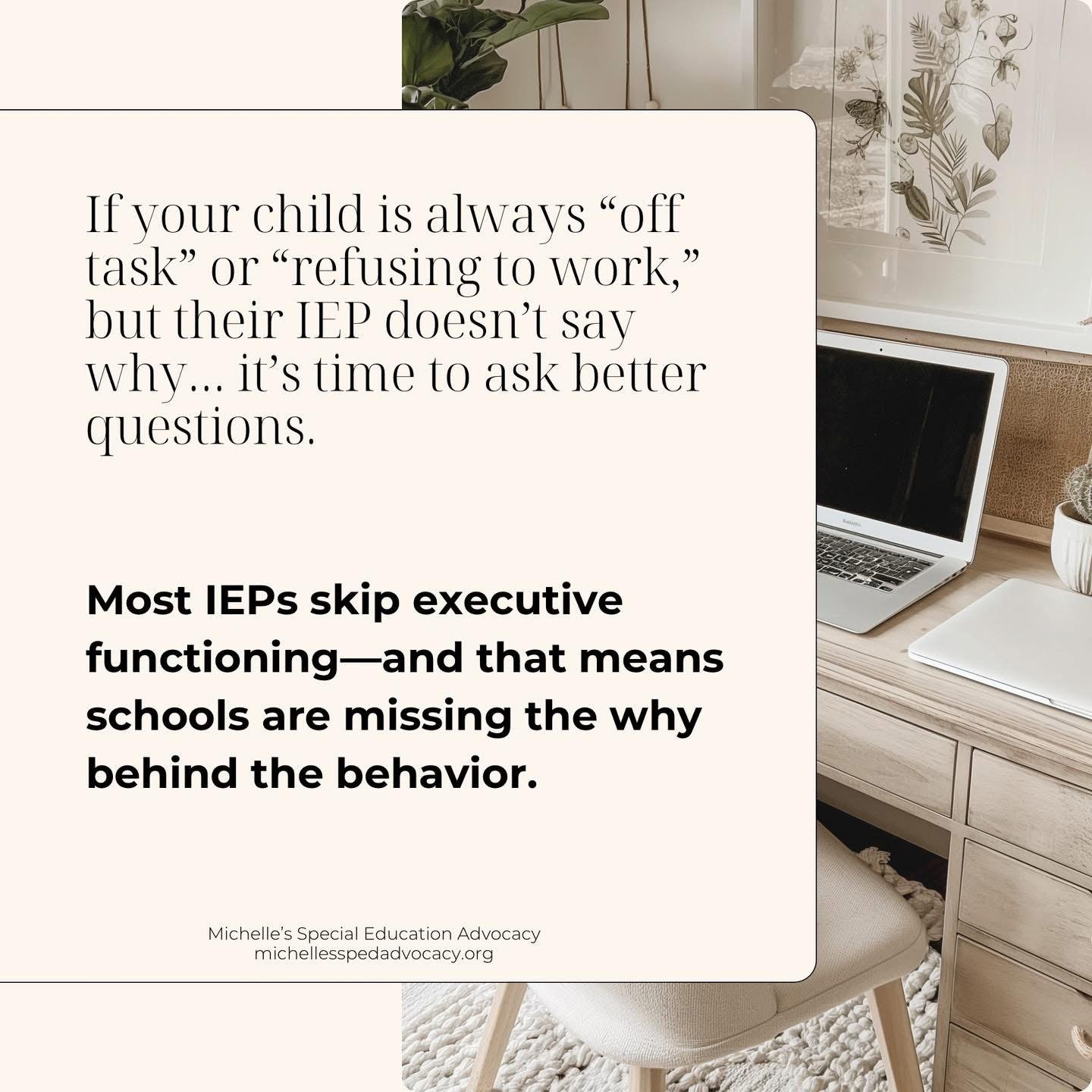
When executive functioning is not clearly identified in the IEP or evaluation process, behavior is often misunderstood — and support comes too late.
When a district says “no,” I do not walk away or back down when the situation becomes difficult. At the same time, I do not approach the process by creating immediate conflict.
There is a difference between reacting and responding, and that distinction matters in these conversations.
In Michael’s case, we remained engaged in the process. We observed, documented, and focused on what was actually happening both at school and at home. Patterns were allowed to emerge over time, and when they became clear, we acted on them.
The focus shifted from proving eligibility to identifying what he needed in that moment to function in the school environment.
That shift is critical.
Support in school is not limited to a single pathway, and waiting for a label does not help a child who is struggling now.
Michael received a 504 plan that included:
executive functioning supports
social and emotional support
accommodations for attention and concentration
counseling and social work services
assistive technology and classroom modifications
While those supports were being implemented, we were also building meaningful data. This included real, observable, school-based information that reflected his daily experience.
That data guided the next steps and supported informed decision-making.
This is why I do not lead with legal threats. It is not because I lack knowledge of the law. I understand federal and state regulations, procedural safeguards, and when something is not appropriate.
However, how those tools are used matters.
Leading with legal language can shift the tone of a meeting quickly. Communication becomes limited, and the focus can move from problem-solving to defensiveness.
When that happens, progress slows.
My role is to keep the process moving forward while holding firm when something is not right.
I do not accept “no” without examination. I work through it, and when necessary, I challenge it directly. I do this in a way that keeps communication intact, because maintaining that connection is often what allows progress to happen.
This work requires both persistence and strategy. It is not about winning a meeting. It is about ensuring that a child receives meaningful, appropriate support.
What This Looks Like When It Works
Over time, Michael’s needs became clearer within the school setting, not only academically, but in his regulation, task engagement, and peer interactions.
At that point, the team adjusted. They did not remain fixed in the original decision, and they did not wait for further escalation or require a formal label before taking action.
I worked alongside the Special Education Director, Principal, general education teacher, school counselor, and social worker to support him across environments.
Supports were based on what was happening in real time.
He was given access to:
regulation breaks in a sensory space
support from the school counselor and social worker
classroom strategies to support engagement and task completion
He remained in general education, with support built around him.
This is what it means to create movement.
It is not limited to qualifying for special education or developing an IEP. It does not require waiting for a formal diagnosis. Support can begin with an identified need.
In this situation, that is exactly what happened.
The focus was not the label.
The focus was access.
If you’re hearing ‘no’ from your child’s school and something doesn’t feel right, it’s worth taking a closer look at what’s really happening.